
"How often should I get a facial?" I get this question more than almost any other. The honest answer can come across as a sales gimmick, but in all honesty, its just based on simple biology.
Your skin runs on a cycle. Once you understand what happens during that cycle, the right schedule becomes obvious. It’s also why a single facial before a wedding or big event never seems to do as much as you hoped.
Let's walk through the 28 days between appointments.
Your Skin Is a Conveyor Belt
The outer layer of your skin, the epidermis, is constantly renewing itself. New cells form at the bottom layer, then slowly travel upward over a few weeks. As they rise, they flatten, lose their nucleus, and become the tough, protective outer layer called the stratum corneum. Eventually they shed.
In your 20s, that whole trip takes about a month. That's where the familiar "28-day skin cycle" comes from.
The catch: the conveyor belt slows down as you age. Research comparing younger and older adults found that epidermal turnover drops by roughly half between your 20s and your 70s (Grove and Kligman, 1983). By your 40s and 50s, a full cycle can take closer to 40 to 60 days.
That slowdown explains a lot of what people describe as "my skin just looks tired now."
What Happens When the Belt Slows Down
When old cells hang around longer than they should, four things happen:
1. Dullness. Healthy, freshly turned-over skin is smooth, so light reflects off it evenly. A buildup of dead cells creates a rough, uneven surface that scatters light. That reads as dull, gray or tired, even when you slept fine.
2. Clogged pores. Dead cells mix with oil and get trapped in the follicle. That's the start of blackheads, bumps and breakouts.
3. Products stop working. Your serums have to get through that buildup before they can do anything. A layer of old cells is a layer of product that never reaches the skin underneath. I wrote more about this in Why Your Skincare Really Isn't Working.
4. Dry, flaky patches. Especially in Arizona, where low humidity pulls water from the skin. Flaky skin isn't always dry skin. Often it's skin that isn't shedding properly.
What a Professional Facial Actually Does
A good facial isn't just a nice lie-down with a sheet mask (although I won't stop you from enjoying that part). In my treatment room, each step has a job:
Deep cleansing removes everything sitting on the surface: oil, SPF, makeup, pollution.
Professional exfoliation uses medical-grade acids or enzymes to dissolve the bonds holding dead cells together. These are stronger and more controlled than what you can safely use at home.
Extractions, when needed, clear what's already trapped in the pores.
Targeted serums and masks go onto freshly exfoliated skin, where they can actually penetrate.
Professional strength LED much stronger than any home device to target that much needed cell rejuvenation.
Calming and protection settle any redness and leave your barrier stronger than you found it.
There's good evidence behind professional exfoliation done in a series. In one study, people with sun-damaged skin who had a series of glycolic acid peels saw improvements in rough texture, fine lines and pigment (Newman et al., 1996). The key word is series. One treatment helps. Repeated treatments build.
Why Monthly, Specifically
Here's where the cycle comes in.
When I exfoliate your skin at a facial, I'm clearing the buildup and resetting the surface. Over the next few weeks, your skin builds a fresh layer. Somewhere around weeks 4 to 6, dead cells start piling up again, especially as you get older and the cycle slows.
A facial every 4 weeks catches your skin right as the buildup returns. You stay ahead of it instead of starting from scratch each time.
Compare that to the "special occasion" pattern, where someone comes in twice a year before big events. Every visit starts from maximum buildup. The skin looks better for a week or two, then slides back. It never gets the chance to build on itself.
Monthly facials also give me something just as valuable: regular eyes on your skin. I notice changes early, like a new patch of pigment, a shift toward breakouts that often signals a hormone change, or a mole that looks different. Catching those early makes everything easier.
The Monthly Rhythm at Home
Your facial and your home routine work as a team. Between visits:
Week 1: Your skin is fresh and absorbs products well. This is the best time to be consistent with your serums.
Weeks 2 to 3: Keep up gentle exfoliation at home 2 or 3 times a week, and use your retinoid on schedule.
Week 4: Buildup starts returning. Skin may look a little duller. That's your cue that your next facial is due.
And every single day: SPF. Daily sunscreen users in a 4.5-year trial showed 24% less skin aging than occasional users (Hughes et al., 2013).
Which Facial for Which Month
You don't need the same facial every time. I adjust based on your skin, the season and what's coming up in your life.
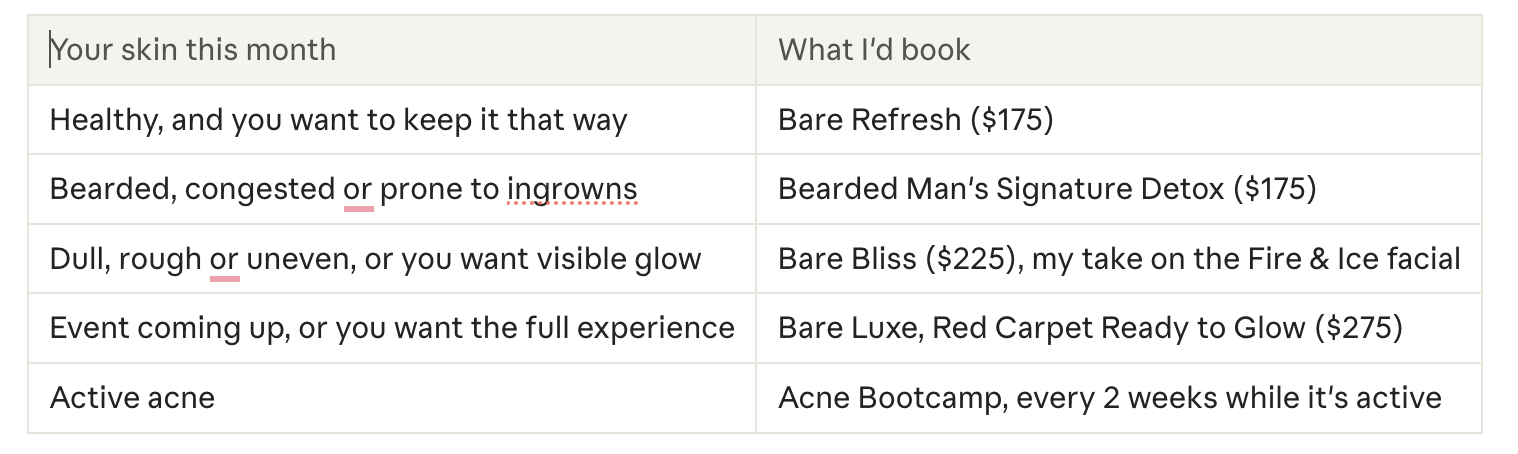
Why Bare Bliss is so popular for dull skin: the "fire" step is a warming resurfacing mask that clears the buildup we've been talking about. The "ice" step calms everything back down, so you walk out glowing instead of red. It's the conveyor belt reset in one visit.
How Membership Makes Monthly Easy
I built Bare's membership around this exact cycle. Your monthly facial becomes a standing appointment, you save on every facial, and you save on the home care that keeps your results going between visits. Most of my regulars are members for one simple reason: it turns "I should really book a facial" into something that just happens.
See how membership works · Book your facial
Frequently Asked Questions
Is monthly too often for sensitive skin? No. For sensitive skin I choose gentler exfoliants and more calming steps. Consistent, gentle care usually calms sensitive skin down over time as your skin becomes healthier.
Can I get a facial every two weeks? For active acne, yes, that's what Acne Bootcamp is for. For those that are addicted to a dermaplane, we can do an express at 2 weeks. For most other skin, every 4 weeks is the sweet spot.
What if I can only come in every other month? That's still far better than twice a year. Lean a little harder on your home exfoliation and retinoid in the off months. We can chat about how to optimize your homecare to get the most of this.
Do men need monthly facials too? Men's skin is thicker and oilier, which makes congestion and ingrowns common. Monthly works well, and the Bearded Man's Signature Detox was built for it.
Can I get a facial while pregnant? Yes, with adjustments. Tell me when you book, and I'll skip ingredients that aren't recommended during pregnancy.
Christalyne Causey, PhD, is a hormone specialist, licensed esthetician and the founder of Bare in Scottsdale, AZ.
Related reading: Stop Calling It Fluff: The Real Science Behind Facial Massage · The Fall Skincare Reset
Sources
Grove GL, Kligman AM. Age-associated changes in human epidermal cell renewal. J Gerontol. 1983;38(2):137-142.
Newman N, et al. Clinical improvement of photoaged skin with 50% glycolic acid: a double-blind vehicle-controlled study. Dermatol Surg. 1996;22(5):455-460.
Hughes MCB, et al. Sunscreen and prevention of skin aging: a randomized trial. Ann Intern Med. 2013;158(11):781-790.