
I don’t think a single week goes by without someone laying down on my treatment table and saying, "My doctor checked my hormones and everything came back normal."
Then they list the symptoms. Exhausted by 2pm. Breaking out along the jaw for the first time since high school. Hair in the shower drain. Weight settling around the middle. . Sleeping badly. Skin suddenly dry, dull and reactive.
I hate to say it but, “normal” labs and a body that feels anything but normal can exist at the same time. Often it comes down to what was checked, when it was checked, and how the results were read alongside your symptoms.
This post walks through the most common hormone and nutrient labs, what each one can reveal, and how it connects to the skin and hair changes that bring most people to Bare. While I might just be an aesthetician to some, I’ve spent years studying hormones and you might as well benefit from my PhD.
Why "Normal" Isn't Always Accurate
Lab reference ranges are built by testing a large group of people and taking the middle of the results. They're designed to specifically flag disease. Which I won’t deny IS important. However, they aren't designed to tell you whether your levels are where you personally feel and function best. Plus, a single result is only a snapshot.
This is why symptoms are just as important to look at. A lab result read next to your history, your cycle, your medications and how you actually feel tells a much fuller story than just a number on its own.
What Common Hormone Labs Can Reveal
Sex hormones
Estradiol. Your main estrogen. It supports collagen, skin thickness and hydration, plus mood, sleep and bone health. When it runs low or swings, skin often gets drier, thinner and slower to heal.
Progesterone. Often the first hormone to decline in your late 30s and 40s. Lower progesterone is commonly associated with poor sleep, anxiety, heavier or irregular periods and worse PMS, all of which tend to show up on your skin too.
Total and free testosterone. Important for women and men. It affects energy, libido, muscle and motivation. In women, higher free testosterone, or more sensitivity to it, can mean jawline acne, oiliness and thinning hair at the crown.
SHBG (sex hormone binding globulin). A protein that carries hormones in your blood. Only the unbound portion is active. Total testosterone can look fine while low SHBG means more of it is free and active, which can help explain acne or hair thinning that "normal" testosterone doesn't seem to account for.
DHEA-S. An adrenal hormone your body uses to make other sex hormones. Elevated levels can be associated with androgen-driven acne.
FSH and LH. Signals from your brain to your ovaries. Rising FSH can be one clue about where you are in the perimenopause transition, although it fluctuates a lot, so it's one piece of a bigger picture.
Thyroid
Your thyroid sets the pace for metabolism, energy, temperature and the speed of cell turnover in your skin and hair.
TSH, free T4 and free T3. Many routine checkups include only TSH, a signal from the brain asking the thyroid to work harder. Free T4 and free T3 show how much active thyroid hormone you actually have.
Thyroid antibodies. These can point to autoimmune thyroid conditions, the most common cause of an underactive thyroid.
An underactive thyroid often shows up on the outside: dry, rough skin, brittle nails, thinning hair (sometimes including the outer third of the eyebrows), puffiness and feeling cold when everyone else is comfortable.
Stress and metabolism
Cortisol. Your main stress hormone. Chronically elevated cortisol is linked to collagen breakdown, a weaker skin barrier and slower healing, which matters for every treatment that depends on your skin repairing itself.
Fasting insulin and hemoglobin A1c. How well your body handles blood sugar. High insulin raises androgen activity and oil production, which is why insulin resistance and adult acne so often show up together.
Nutrients that show up on your skin and hair
Ferritin. Your iron stores. Low ferritin is a common contributor to hair shedding in women, especially those with heavy periods.
Vitamin D. Involved in immune function, mood and skin health. Plenty of people living in sunny places are still low, thanks to sunscreen and indoor lives.
Vitamin B12. Needed for energy and healthy cell production. Low levels are more common with certain diets and medications.
Timing Is Important
For women who still have a cycle, timing of when labs are drawn can change the meaning of the numbers. Progesterone, for example, is usually most meaningful about a week after ovulation, and some hormones are typically checked in the morning. If your doctor orders hormone labs, ask when in your cycle and what time of day they should be drawn.
How It Can Show Up on Your Skin
This is where my work comes in. Your skin sits downstream of everything above and it tends to tell a story.
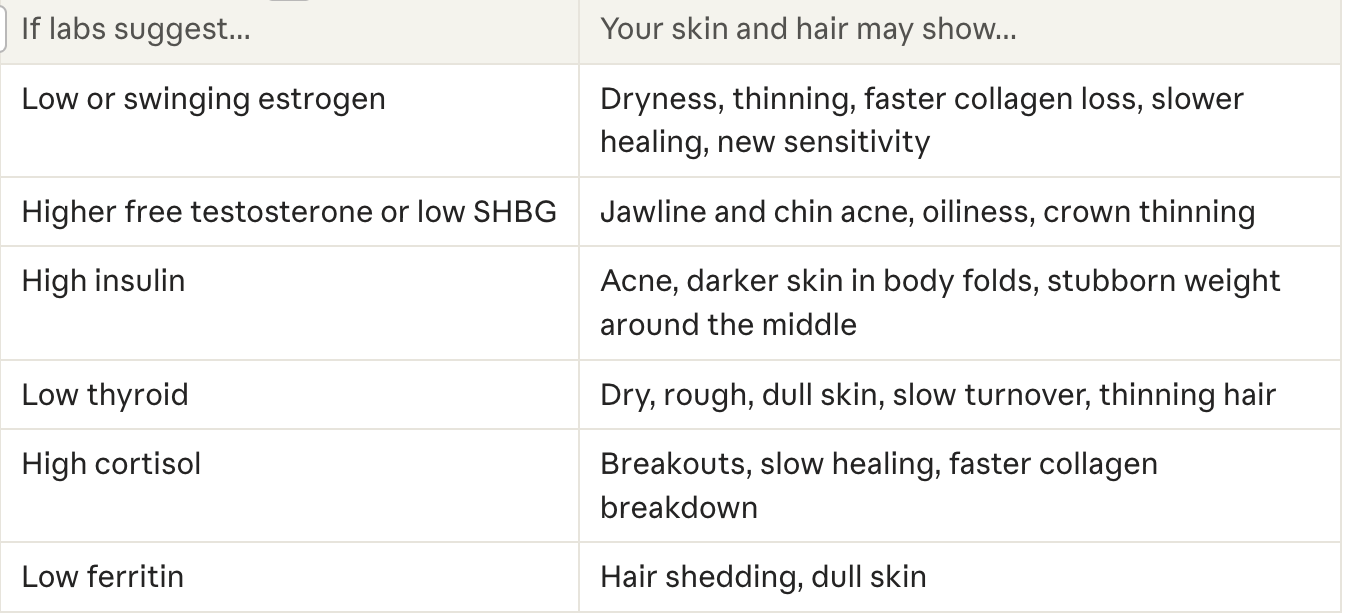
These are patterns, not diagnoses. Plenty of skin changes have other causes, which is why you should have open communication with your doctor. Read more about how hormone shifts show up as adult breakouts in The Hormone–Skin Connection: Why You're Suddenly Breaking Out at 40.
For the Men Reading This
Testosterone declines gradually with age, and low levels are associated with low energy, lower drive, slower recovery, more fat around the middle, thinner skin and slower healing. If that sounds familiar, it's worth asking your doctor about testosterone, thyroid, blood sugar and vitamin D. My guide to aging well for men goes deeper.
Questions to Bring to Your Doctor
If your skin, hair, energy or sleep changed and you suspect hormones, these questions can make your appointment more productive:
"Can we check free T4 and free T3 along with TSH?"
"Can we look at free testosterone and SHBG, not just total testosterone?"
"Should we check ferritin, given my hair shedding?"
"Should we check fasting insulin or A1c?"
"When in my cycle should these be drawn?"
"Could perimenopause explain what I'm feeling?"
Write down all your symptoms and when they started before you go. Doctors can do much more with a clear symptom history.
How a Wellness Consult at Bare Works
A wellness consult with me is a conversation about how your body, symptoms and your skin are connected. It doesn't replace your doctor. It actually helps you to get more out of your care.
We talk through your story: your skin, hair, cycle, sleep, energy, stress, nutrition and what's changed.
Bring recent labs if you have them. I'll explain in plain English how what they show may be showing up on your skin. If you don't have labs, I'll help you think through which questions to bring to your doctor.
We build your plan: skin treatments, home care, nutrition, and lifestyle steps that support what's happening inside. My specialty is optimizing your health and hormones naturally through easy and sustainable diet and lifestyle adjustments.
Anything medical goes back to your doctor. If something needs medical attention, I'll tell you to follow up with your physician.
Frequently Asked Questions
Does Bare order lab tests? No. Labs are ordered by your physician. I can help you understand how your results may relate to you.
Do I need labs before my consult? No. If you have recent results, bring them. If not, we'll start with your symptoms and history.
Can you prescribe hormones? No. I'm not a medical doctor, and decisions about hormone therapy belong with your physician.
Can I have labs drawn while on birth control? Yes, but hormonal birth control changes how some results are read.
My doctor only checked TSH. Should I ask for more? It's reasonable to ask whether free T4, free T3 or antibodies make sense for you, especially if your symptoms continue.
Christalyne Causey, PhD, is a hormone specialist, licensed esthetician and the founder of Bare Aesthetics in Scottsdale, AZ. She is not a medical doctor. This post is educational and is not a substitute for medical advice, diagnosis or treatment. Talk with your physician about lab testing and any medical concerns.
If labs suggest...
Your skin and hair may show...
Low or swinging estrogen
Dryness, thinning, faster collagen loss, slower healing, new sensitivity
Higher free testosterone or low SHBG
Jawline and chin acne, oiliness, crown thinning
High insulin
Acne, darker skin in body folds, stubborn weight around the middle
Low thyroid
Dry, rough, dull skin, slow turnover, thinning hair
High cortisol
Breakouts, slow healing, faster collagen breakdown
Low ferritin
Hair shedding, dull skin
These are patterns, not diagnoses. Plenty of skin changes have other causes, which is exactly why the conversation with your doctor matters. Read more about how hormone shifts show up as adult breakouts in The Hormone–Skin Connection: Why You're Suddenly Breaking Out at 40.
For the Men Reading This
Testosterone declines gradually with age, and low levels are associated with low energy, lower drive, slower recovery, more fat around the middle, thinner skin and slower healing. If that sounds familiar, it's worth asking your doctor about testosterone, thyroid, blood sugar and vitamin D. My guide to aging well for men goes deeper.
Questions to Bring to Your Doctor
If your skin, hair, energy or sleep changed and you suspect hormones, these questions can make your appointment more productive:
"Can we check free T4 and free T3 along with TSH?"
"Can we look at free testosterone and SHBG, not just total testosterone?"
"Should we check ferritin, given my hair shedding?"
"Should we check fasting insulin or A1c?"
"When in my cycle should these be drawn?"
"Could perimenopause explain what I'm feeling?"
Write down your symptoms and when they started before you go. Doctors can do much more with a clear symptom history.
How a Hormone Consult at Bare Works
A hormone consult with me is a conversation about how your body and your skin are connected. It doesn't replace your doctor. It helps you get more out of your care.
We talk through your story: your skin, hair, cycle, sleep, energy, stress, nutrition and what's changed.
Bring recent labs if you have them. I'll explain in plain English how what they show may be showing up on your skin. If you don't have labs, I'll help you think through which questions to bring to your doctor.
We build your plan: skin treatments, home care, nutrition and lifestyle steps that support what's happening inside.
Anything medical goes back to your doctor. If something needs medical attention, I'll tell you to follow up with your physician.
Frequently Asked Questions
Does Bare order lab tests? No. Labs are ordered by your physician. I can help you understand how your results may relate to your skin.
Do I need labs before my consult? No. If you have recent results, bring them. If not, we'll start with your symptoms and history.
Can you prescribe hormones? No. I'm not a medical doctor, and decisions about hormone therapy belong with your physician.
Can I have labs drawn while on birth control? Yes, but hormonal birth control changes how some results are read. Make sure your doctor knows what you're taking.
My doctor only checked TSH. Should I ask for more? It's reasonable to ask whether free T4, free T3 or antibodies make sense for you, especially if your symptoms continue.
Christalyne Causey, PhD, is a hormone specialist, licensed esthetician and the founder of Bare in Scottsdale, AZ. She is not a medical doctor. This post is educational and is not a substitute for medical advice, diagnosis or treatment. Talk with your physician about lab testing and any medical concerns.