
You're 42. You have a 401(k), a skincare fridge and a firm opinion about thread count. And you have three angry bumps on your chin.
So you do what you did at 15. You grab the strongest acne wash at the drugstore, a spot treatment that smells like a swimming pool, and maybe a scrub for good measure. A week later, your skin is red, tight, flaking around your nose, and still breaking out.
That isn't a dirty skin issue or you not blasting the pimple with enough force. Those products were designed for a different kind of skin.
Adult Acne Is Common, and It's Different
If you're breaking out as an adult, you have plenty of company. In one large study of women, acne affected about half of women in their 20s, more than a third in their 30s, about a quarter in their 40s, and around 15% of women over 50 (Collier et al., 2008).
Adult acne tends to look and behave differently from teen acne:
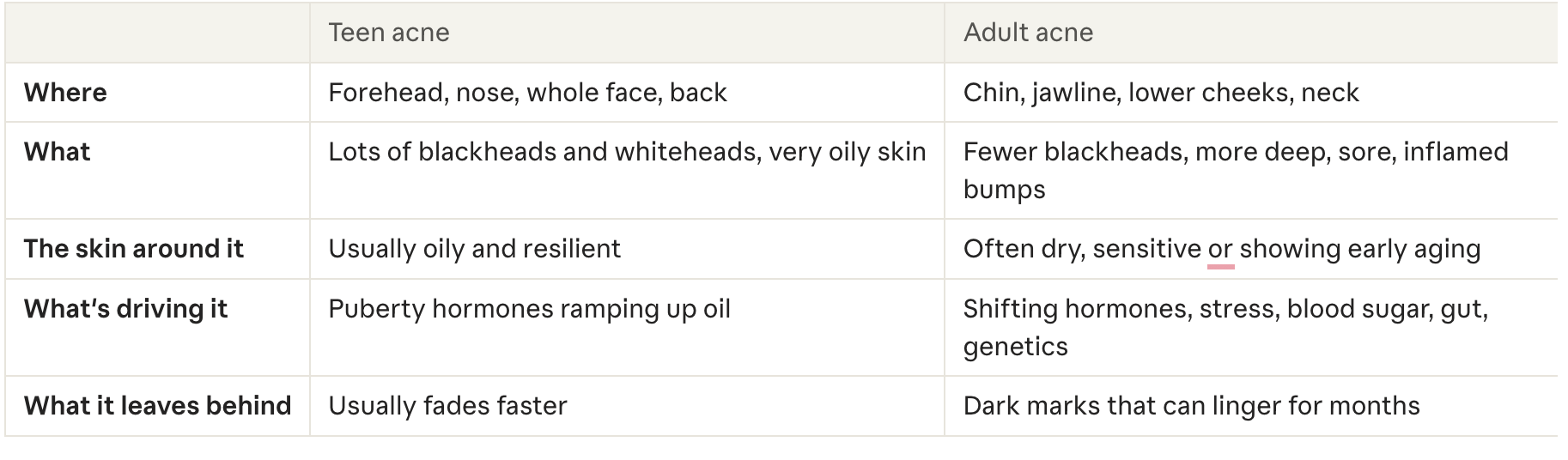
Pay attention to that last line. Adult skin heals more slowly, so every inflamed breakout is more likely to leave a dark spot (post-inflammatory hyperpigmentation) that outlasts the pimple by months.
Five Ways Teen Products Backfire on Adult Skin
1. They're built to strip oil you don't have
Teen acne products assume a face full of oil. Harsh foaming cleansers and alcohol-heavy toners strip the lipids that hold your barrier together. I don't like these products for kids, and I really hate them for adults. Adult skin, which is already producing less of those lipids, loses water faster, gets irritated, and often responds by breaking out more.
2. Stronger isn't better
More is not more with acne actives. In a classic study, 2.5% benzoyl peroxide worked about as well as 5% and 10% on acne, with noticeably less irritation (Mills et al., 1986). Many adults are using the 10% version and paying for it in redness and peeling.
3. Scrubs make inflamed acne worse
Gritty scrubs drag across inflamed bumps, spread bacteria, and create tiny tears in already-fragile skin. Adult acne needs inflammation calmed, not scraped.
4. They ignore the dark marks
Most teen products treat the pimple and stop there. For adults, the mark left behind is often the bigger frustration. A routine that doesn't address pigment leaves you clear but blotchy.
5. Some ingredients don't belong on hormone-sensitive skin
If your breakouts are hormone-driven, it makes sense to be thoughtful about what you're putting on your skin every day. Some common cosmetic ingredients, such as certain parabens and the sunscreen filter oxybenzone, Homosalate, and Octinoxate, have shown weak hormone-like activity in laboratory studies. The real-world impact is still being studied, but I'd rather avoid them when great alternatives exist. That's why Bare's ingredient standard excludes known endocrine disruptors.
What Actually Works for Adult Acne
The goal for adult skin is to clear pores, calm inflammation, fade marks and protect the barrier, all at the same time.
Salicylic acid or mandelic acid. Oil-soluble salicylic acid gets inside the pore to loosen the buildup. Mandelic acid is a gentler, larger-molecule acid that's great for sensitive and deeper skin tones.
A retinoid. Retinoids keep cells from sticking together inside the pore, which is the root of acne-prone skin. They also help fade marks and build collagen, so you get anti-aging and acne care in one step. Start slow.
Azelaic acid. One of the most underrated ingredients for adults. It calms inflammation, helps clear breakouts and fades dark marks, and it's gentle enough for sensitive skin.
Niacinamide. Calms redness and supports the barrier. In one study, a 4% niacinamide gel performed comparably to a topical antibiotic gel for inflammatory acne (Shalita et al., 1995).
Barrier support. A moisturizer that replaces lipids. Yes, even with acne. A healthy barrier heals faster and tolerates your actives better.
Sunscreen that won't clog. Sun darkens post-breakout marks. Daily SPF is part of acne treatment.
Why I Made The Bare Effect Line
For years I kept seeing the same client: a grown woman with a great routine, still breaking out like she was 15. The products made for acne were too harsh for her skin. The products made for her age did nothing for her breakouts.
So I made my own. The Bare Effect line was built for adult acne: effective acne ingredients, without over-drying, without known endocrine disruptors, and with the barrier support adult skin needs. For specific cases, I layer in iS Clinical and Epionce products.
Why the Right Products Still Aren't the Whole Answer
At Bare, I treat acne as three things working together: genetics, gut and hormones.
Genetics: acne-prone pores shed dead cells much faster than other pores, up to 10 times faster, and those cells stick together. This is the part great skincare handles.
Gut: blood sugar spikes raise insulin and IGF-1, which increase oil and cell buildup. I wrote about it in Gut Health and Acne.
Hormones: shifting androgens drive chin and jawline breakouts. More in The Hormone–Skin Connection, and here's what a hormone panel can tell you about your skin.
When skincare alone isn't enough, Acne Bootcamp clears congestion and calms inflammation in the office, repeatable every 2 weeks while acne is active.
Don't Buy Another Acne Product Until You Read This
The fastest way to waste money on adult acne is guessing. A product that's perfect for your best friend's breakouts can wreck your barrier.
Send me a photo. Reply to any of my emails or DM me on Instagram with a photo of your skin and your current routine. I'll tell you where to start.
Book Acne Bootcamp or a consult. We'll look at your skin and, when it makes sense, what's driving it from the inside. Book here.
Frequently Asked Questions
How long until I see results? Give a new routine 8 to 12 weeks. Breakouts form weeks before you see them.
Should I stop wearing makeup? Not necessarily. Choose non-comedogenic products and wash them off every night. More often than not it is dirty applicators that are the issue.
Can I use retinoids if I'm trying to get pregnant? No. Skip retinoids if you're pregnant or trying. Azelaic and mandelic acids are great alternatives. Ask me first.
Will birth control fix my acne? For some people, it helps, but it doesn't address blood sugar or gut factors, and acne can return with a vengeance when you stop. It's worth looking into all the factors regardless.
Is it my diet? Often it's part of the picture, especially high-sugar foods and, for some people, things like milk or eggs. Keep in mind that it is rarely the only cause.
Your Next Step: Stop Guessing. Book Acne Bootcamp.
Every wrong product costs you money and another round of dark marks. In Acne Bootcamp, I clear what's clogged, calm the inflammation and send you home with a routine made for adult skin.
Not sure it's for you? DM me a photo of your skin and your current routine on Instagram @bare.aesthetics, and I'll tell you where to start.
Sources
Collier CN, et al. The prevalence of acne in adults 20 years and older. J Am Acad Dermatol. 2008;58(1):56-59.
Mills OH Jr, et al. Comparing 2.5%, 5%, and 10% benzoyl peroxide on inflammatory acne vulgaris. Int J Dermatol. 1986;25(10):664-667.
Shalita AR, et al. Topical nicotinamide compared with clindamycin gel in the treatment of inflammatory acne vulgaris. Int J Dermatol. 1995;34(6):434-437.