
Why Sephora Can't Sell You What Your Skin Actually Needs (And What "Medical-Grade" Really Means)
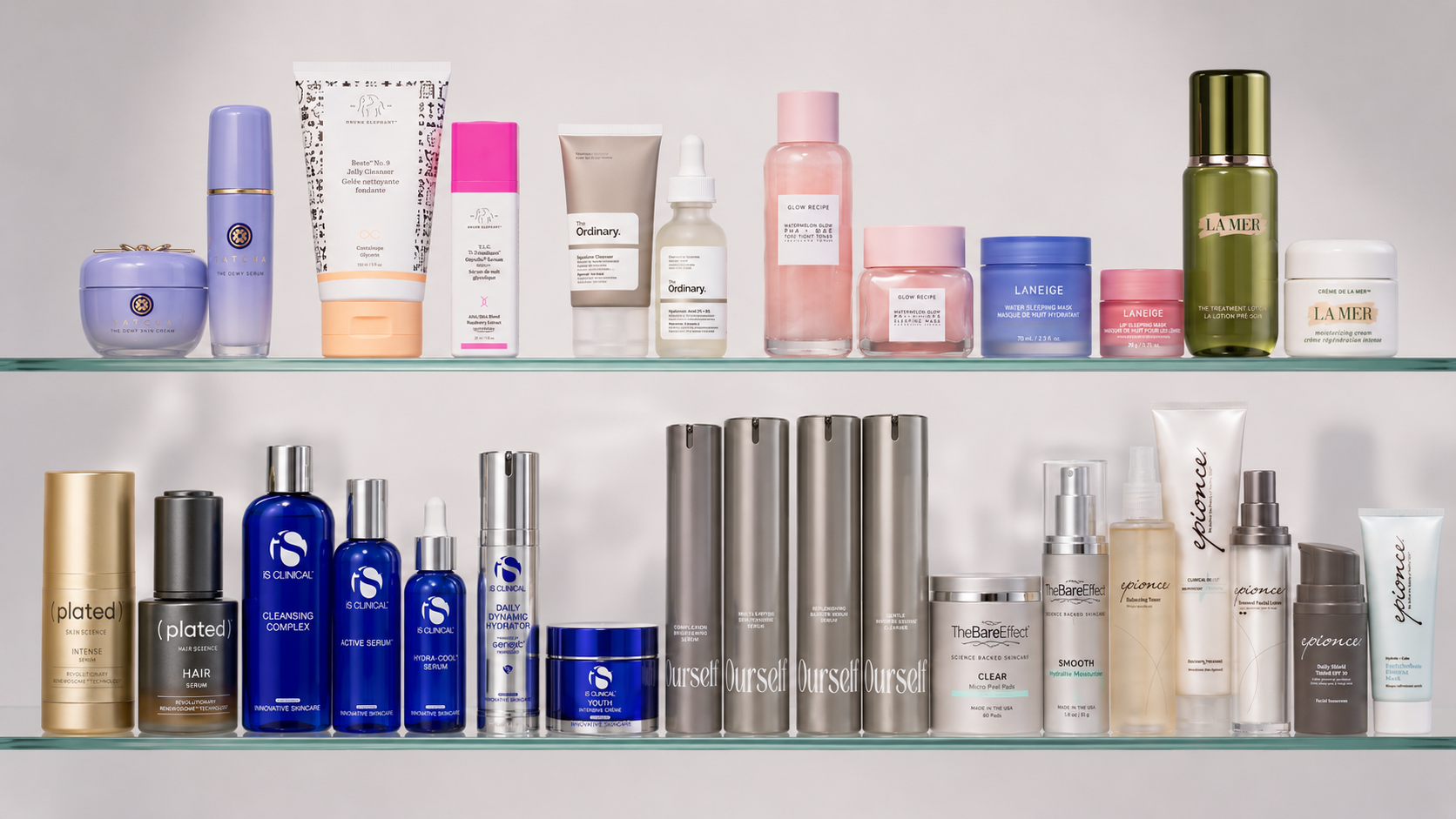
I made this image with AI. It didn’t do that great of a job.
Walk into Sephora and you will find floor-to-ceiling walls of skincare products with confident claims, clinical-sounding names, and price tags that suggest serious science is happening inside the bottle. Some of them cost more than a professional treatment. Most of them are cosmetics. The majority to as little as a drugstore brand.
The Regulatory Reality Nobody Puts on a Label
The FDA classifies most skincare as cosmetics. This category includes everything from your $4 drugstore moisturizer to a $200 La Mer face cream. The cosmetic category has two requirements: products must be safe, and they must be accurately labeled. There is no requirement to prove they work.
This means a brand can claim their product "visibly reduces the appearance of fine lines" without a single peer-reviewed study. They can list retinol, peptides, or vitamin C on the label without specifying concentrations or confirming those ingredients are present at amounts that do anything clinically meaningful.
"Clinically proven" typically means the brand itself ran a study. Not that the study was rigorous, blinded, controlled, peer reviewed or published. "Dermatologist tested" almost always means a dermatologist was paid to confirm the product didn't irritate a small group of people. In other words, if a brand has enough money to jump through a few hoops, it can claim whatever it wants.
Sephora's business model is built on selling products in this regulatory environment at luxury price points. The premium you pay covers the brand story, the influencer campaign, the packaging design, and the Sephora shelf fee, not the formulation science. A $90 Sephora serum and a $9 drugstore moisturizer are both cosmetics. Neither has to prove it works. The gap between them is almost entirely marketing.
This isn't cynicism. It's the structure of cosmetic regulation, and once you understand it, you cannot un-see it in a Sephora aisle. Believe me, learning all of this completely ruined me for any Sephora or Ulta sale.
What "Medical-Grade" Actually Means (And Doesn't)
Here's where I'll also correct a term you'll hear from providers like me: "medical-grade" is not an FDA term either. There is no official regulatory category by that name. The skincare industry coined it, it implied authority, and it stuck.
The accurate term is professional-grade, referring to products sold exclusively through licensed providers: aestheticians, nurses, physicians, and other credentialed practitioners.
The licensing requirement is not arbitrary or promotional. Professional-grade products are formulated at concentrations that require professional guidance to introduce safely. A high-percentage retinoid needs proper onboarding to manage the initial purging and irritation period. Some professional-dispensed products like tretinoin, hydroquinone above 2%, and certain prescription AHAs, are FDA-classified drugs, meaning they do require clinical validation and a prescription. Others remain cosmetics under FDA rules but are formulated to a standard that no shelf brand approaches.
The label doesn't create the difference. The formulation science does. And that science comes down to three things.
1. Concentration: The Threshold That Makes or Breaks Results
Every active ingredient has a concentration threshold. This is a minimum amount below which it does not produce a measurable clinical effect. Research on well-studied actives has helped establish where these thresholds sit. And a significant portion of mass-market and Sephora products are formulated below them.
Retinol is the clearest example as it is one of the most well studied ingredients out there. Decades of randomized controlled trials document retinol's effects on collagen synthesis, cellular turnover, and hyperpigmentation at therapeutic concentrations. Drugstore and most Sephora products contain 0.025–0.1% retinol. Professional-grade retinol formulations start at 0.25%. The lowest prescription of tretinoin, the active retinoic acid that skin enzymatically converts OTC retinol into, provides roughly 10x the biological activity per unit compared to typical OTC products.
The retinol in a popular Sephora brand and the tretinoin dispensed at a licensed clinic are categorically different interventions. The first might barely clear the activity threshold. The second is the intervention the clinical studies were actually testing.
The same pattern holds for vitamin C, niacinamide, azelaic acid, and peptides. The ingredient on a Sephora label and the ingredient present in your skin at a clinically active concentration are two very different things.
2. Delivery: Getting Past Your Skin's Barrier
Your skin is not a passive surface. It’s job is to actually protect your body. The stratum corneum, the outermost layer, is a sophisticated barrier evolved to keep the external environment out. Think of it like the bouncer or door man for your skin. It does its job very well, which is great for your health. Unfortunately it is also very inconvenient for skincare.
For a topically applied active to produce a structural change in the skin, it has to cross the stratum corneum and reach the viable epidermis and dermis beneath it where fibroblasts produce collagen, melanocytes regulate pigmentation, and keratinocytes differentiate. These cells are what you want to reach. Most products never get past the bouncer.
Professional-grade formulations invest (a lot of money) in delivery technology specifically designed to solve this. Liposomal encapsulation protects lipophilic actives and facilitates transport through the skin's lipid matrix. Microemulsions increase apparent solubility and dermal penetration. I understand that may sound like just a bunch of fancy words, but understand that these technologies are expensive to develop and produce, which is exactly why Sephora brands, operating at scale with retail margin constraints, don't invest in them.
An ingredient on a Sephora label may or may not be in your skin. A professional-grade formulation with a validated delivery system can be confirmed to reach the cell layers where it needs to act.
3. Shelf Stability: The Active That Wasn't There When You Opened It
This one catches people off guard and is one of the most frustrating for those of us who have formulated (or tried to) our own products
Many skincare actives are chemically unstable. L-ascorbic acid (vitamin C) oxidizes rapidly on contact with air and light. The color shift from pale yellow to amber or orange-brown is the visual signal that the oxidation has occurred and the antioxidant activity is gone. Retinol degrades under UV exposure. Once degraded, these ingredients don't produce the effects they're known for, regardless of what's printed on the label.
Professional-grade formulations use stabilized vitamin C derivatives, encapsulated retinol, UV-protective and airless packaging, and faster supply chains that minimize the time products spend on shelves or in warehouses. The product that arrives at Bare and goes home with a patient is close in formulation and potency to what was tested in clinical development.
If you’ve been with me through my own product formulation struggles, you know that I had 3 different variations of my Brighten C before I settled on one that I was confident would stay shelf stable throughout my client’s full use of it.
The vitamin C serum you bought at Sephora six months ago and kept in a clear bottle on your bathroom counter? It may have started oxidizing before you got through the first third of it. You've been applying a progressively less active product and wondering why you're not seeing results.
What to Actually Look For
Navigating this requires asking a few questions that no Sephora sales associate is equipped to answer (It’s not their fault. The companies don’t disclose most of this information):
What is the active ingredient concentration?
What is the delivery mechanism?
How is the product packaged to protect stability?
Where was the clinical efficacy established, and at what concentration?
If a brand can't answer those questions, or answers with "clinically proven" without specifics, you have your answer.
At Bare, every product in our dispensary can be explained on those terms. We carry formulations because the science supports them, not because the branding is compelling. And when you come in for a skincare consultation, we'll match you with what your skin specifically needs, including telling you honestly when something you're already using is working.
Book a Skincare Consultation at Bare → HERE
Christalyne Causey is the founder of Bare and holds a PhD in [field]. She specializes in evidence-based aesthetics and hormone-informed skin health.