
Peptides vs. Growth Factors vs. Exosomes vs. PDRN: What’s All The Hype About?
Every few years, skincare picks a new magic word. Right now it's a four-way tie between peptides, growth factors, exosomes, and the newest arrival, PDRN (better known online as "salmon DNA"). They show up on serums, on facial menus, and all over your feed, usually with "regenerative" somewhere nearby and an influencer claiming to be “obsessed” without actually sharing any information on what all the hype is about.
I get asked about these four frequently, and I understand the confusion, I see the same targeted marketing you do. They overlap in so many ways and are often marketed interchangeably. Some of the claims are backed by solid research and some are backed by a very good graphic designer and marketing budget.
So let's sort it out: what each one is, what the studies actually show, where each one fits, and the one factor that decides whether any of them works for you.
The One-Sentence Version
If you only read this far:
Peptides are short, simple messages that tell your skin to do one specific thing. Great for daily home care.
Growth factors are bigger, more complex messages your own cells use to coordinate repair. Powerful, but they need help getting in.
Exosomes are tiny packages that carry many messages at once, including growth factors and genetic instructions. Most promising when paired with an in-office treatment, with the caveat that the science is still young.
PDRN is purified DNA fragments that supply your cells with raw materials for repair and calm inflammation. Strong research for wound healing, early research for aesthetics.
I like to think of them as a text message, a phone call, a care package, and a supply delivery. Keep that in mind as you read the rest of this post to help it all make sense.
A Two-Minute Biology Lesson: Your Skin Runs on Signals
Deep in your dermis live cells called fibroblasts. Think of them as your collagen factories. They also make elastin (bounce) and hyaluronic acid (hydration). When you're young, they get constant, clear instructions to keep building.
With time, those instructions get quieter. Collagen production declines steadily through adulthood, and for women the drop speeds up sharply at menopause: research shows skin collagen falls by roughly 30% in the first five years after menopause. ⚑ (Brincat et al.)
Every product and treatment in this post is trying to do the same basic thing: send your fibroblasts a louder, clearer message to rebuild. They differ in how big the message is, how it gets delivered, and how much we actually know about it.
Peptides: The Text Message
What they are
Peptides are short chains of amino acids, the same building blocks that make up proteins like collagen. Think of them as fragments of the messages your body already uses. When collagen breaks down, it leaves peptide fragments behind, and your skin reads those fragments as "damage happened here, rebuild." Many cosmetic peptides are designed to mimic that signal.
Not all peptides do the same job. The main types you'll see:
Signal peptides (like palmitoyl pentapeptide-4, sold as Matrixyl) tell fibroblasts to make more collagen.
Carrier peptides (like copper peptide GHK-Cu) deliver trace minerals that support wound healing and remodeling. GHK is naturally present in your blood, and levels fall significantly with age. ⚑
Neurotransmitter-inhibiting peptides (like acetyl hexapeptide-8, sold as Argireline) soften the muscle signal that creates expression lines. Think of it as a very gentle, topical cousin of the "relax the muscle" idea.
What the research says
Peptides are one of the better-studied cosmetic ingredients:
In a 12-week double-blind, placebo-controlled study, palmitoyl pentapeptide-4 significantly improved wrinkles and fine lines compared with placebo, and was well tolerated. (Robinson et al., 2005) ⚑
In an early study of acetyl hexapeptide-8, a 10% cream reduced wrinkle depth by up to 30% after 30 days. (Blanes-Mira et al., 2002) ⚑ Worth knowing: that was a small study, and results in later research have been more modest.
The catch: getting in
Your skin's outer layer is built to keep things out. There's a well-known rule of thumb in dermatology called the 500 Dalton rule: molecules smaller than about 500 Daltons (a unit of molecular weight) penetrate intact skin much more easily than larger ones. (Bos & Meinardi, 2000)
Many cosmetic peptides land right around or a bit above that line. So they can get in, but formulation and delivery make an enormous difference. This is why I'm particular about the peptide products I carry. Ourself Advanced Regenerative Serum uses a tiered-release vesicle system to carry its peptides (plus hyaluronic acid and vitamin C) deeper than a standard serum would.
Best for: daily prevention and maintenance at home, in your 20s through forever. Low risk, well studied, and easy to layer with retinoids and SPF.
Growth Factors: The Phone Call
What they are
Growth factors are signaling proteins your cells make to coordinate healing. You've got a whole crew of them: EGF (epidermal growth factor), TGF-β, PDGF, VEGF, and more. When you get a cut, these are the molecules shouting "repair crew, over here," recruiting cells, building new blood vessels, and turning on collagen production.
Growth factor skincare usually gets them from one of three places:
Human cell-derived: collected from fibroblasts or stem cells grown in a lab (the "conditioned media").
Plant-bioengineered: human-identical growth factors produced in plants like barley.
Bio-identical synthetic: lab-made versions that match your body's own.
What the research says
One of the earliest studies followed 14 patients using a topical growth factor serum twice daily for 60 days. About 79% showed clinical improvement, and skin biopsies showed a 37% increase in new collagen formation and a 30% increase in epidermal thickness. (Fitzpatrick & Rostan, 2003) ⚑
Since then, a 2023 systematic review of topical growth factor preparations concluded they show real promise for skin rejuvenation, with the caveat that most studies are small and many are industry-funded. (Quinlan et al., 2023) ⚑ Fair, and the same is true for a lot of skincare research.
The catch: size
Growth factors are big. EGF is roughly 6,000 Daltons. TGF-β is around 25,000. Compare that with the 500 Dalton rule of thumb and you can see the problem: on intact skin, most of a growth factor serum has a hard time getting where it needs to go.
That's why growth factors do their best work when we open a doorway first. Microneedling and lasers create thousands of microscopic channels that let larger molecules reach the dermis directly. It's also why our Ultra Hair Restoration protocol pairs The Ultra laser with KeraFactor, a growth factor serum, instead of just handing you a bottle for your scalp.
Fun fact: microneedling also makes your body release its own growth factors (PDGF, TGF-β, VEGF) as part of the healing response. That's a big part of why it works.
Best for: in-office pairing with microneedling or laser, and targeted protocols like hair restoration.
Exosomes: The Care Package
What they are
Exosomes are tiny bubbles, about 30 to 150 nanometers across, that cells release to communicate with each other. Instead of sending one message, a cell packs a whole kit inside a protective lipid envelope: growth factors, other proteins, lipids, and microRNA (small genetic instructions that tell the receiving cell which genes to turn up or down).
That envelope protects the cargo, and it's designed by nature to be taken up by other cells. So instead of a single signal, an exosome delivers a coordinated set of instructions.
Where they come from (pay attention)
"Exosomes" on a label can mean very different things:
Human stem cell-derived (often from adipose tissue or umbilical sources)
Plant-derived (rose and other plant "exosome-like" vesicles)
Other animal or bioengineered sources
These are not interchangeable. A plant vesicle doesn't carry human signaling molecules, and the concentration, purity, and processing vary a lot from brand to brand. When someone tells you they offer "exosomes," the first question to ask is: from what?
At Bare, I use INVO Aesthetics. Their BioBlend formula comes from human cell sources (dermal fibroblasts, umbilical cord Wharton's jelly, and bone marrow stem cells) ⚑, and it happens to combine the first three things in this post: over 1,200 growth factors, proteins, and peptides plus more than 361 billion exosomes per milliliter, according to the company. What sold me was the transparency. INVO had the formula characterized by independent labs (protein analysis, nanoparticle counts, electron microscopy, gene expression, and cellular safety testing), and they're upfront that this is lab characterization, not a clinical trial. That's the kind of honesty I look for in a brand.
What the research says
The clinical research is young but encouraging, and the best studies pair exosomes with an in-office procedure:
Acne scars: In a 12-week double-blind, randomized, split-face study of 25 patients, one side of the face got fractional CO2 laser plus a human adipose stem cell exosome gel, and the other got laser plus a control gel. The exosome side improved by 32.5% versus 19.9%, with less redness and shorter downtime. (Kwon et al., 2020) ⚑
Skin aging: In a 12-week randomized split-face study, microneedling plus exosomes improved wrinkles, elasticity, hydration, and pigmentation more than microneedling with saline. (Park et al., 2023) ⚑
Here's what I'd want to know if I were a client:
There are no FDA-approved exosome products. The FDA has issued consumer alerts (first in 2020, updated in 2024) warning about exosome products marketed to treat diseases or conditions. Topical exosome products used in aesthetics are generally sold as cosmetics, which means they're applied to the skin and aren't approved to treat any medical condition.
Long-term data is limited. Most studies are small and run 12 weeks or less.
Quality varies. Source, processing, and concentration all affect what you're getting.
So why do I use them? Consistency. I moved away from PRP because its results depend on your individual platelet count, your health that day, and how the sample is processed. A well-sourced, lab-characterized exosome product like INVO gives me a standardized, measured stimulus every time, and in my experience the difference in healing and results after microneedling, Tixel or laser is visibly noticeable.
Best for: boosting microneedling or laser results, especially for texture, scarring, and overall skin quality.
PDRN: The Supply Delivery
What it is
PDRN stands for polydeoxyribonucleotide, which is a very long way of saying "fragments of DNA." It's purified from salmon or trout (hence the viral "salmon sperm facial"), and it's been used in medicine in Europe and Korea for years, mostly for wound healing.
It works a little differently from the other three. Peptides, growth factors, and exosomes mostly send instructions. PDRN does two things:
It supplies raw materials. As PDRN breaks down, it releases nucleotides, the building blocks your cells need to repair DNA and make new cells. Your body can recycle these through what's called the salvage pathway, which saves damaged or stressed tissue a lot of energy.
It calms the job site. PDRN activates adenosine A2A receptors, which turns down inflammation and supports new blood vessel growth, so repair can happen in a calmer, better-supplied environment.
If the others are messages telling your fibroblasts to rebuild, PDRN is the truck that shows up with lumber and a crew that keeps the site from catching fire.
You'll also see PN (polynucleotides) mentioned alongside it. Same source, longer DNA chains. PN is used more like a scaffold in injectable "skin boosters" (Rejuran is the best-known brand), while PDRN is a shorter, more fragmented version.
What the research says
I think it's important to separate two very different bodies of evidence.
Wound healing: strong. In a randomized, placebo-controlled trial of 216 people with diabetic foot ulcers, 37.3% of wounds treated with PDRN fully closed by 8 weeks, compared with 18.9% on placebo. That's roughly double. (Squadrito et al., 2014, summarized in Squadrito et al., 2017) ⚑
Aesthetics: early. Most of the cosmetic research comes from small studies of injected PDRN and PN, much of it from Korea and Italy, looking at skin texture, fine lines, and scarring. The results are encouraging, but the studies are smaller and shorter than I'd like, and topical PDRN has even less direct data behind it.
The catch: size and regulation
PDRN molecules are huge: roughly 50,000 to 1,500,000 Daltons. (Squadrito et al., 2017) Remember our 500 Dalton rule? A PDRN serum on intact skin is mostly staying on the surface. Like growth factors and exosomes, it would need a doorway like microneedling to reach the dermis.
On the regulatory side: as of now, no injectable PDRN or PN product is FDA-approved in the US. Topical PDRN serums are sold legally as cosmetics, but some clinics use imported injectable products off-label, outside FDA oversight. PDRN is also derived from fish, so anyone with a fish allergy should steer clear.
Why I don't offer it (yet)
I get asked about PDRN a lot, so here's my honest answer. I don't do injectables at Bare, which rules out the form with the most aesthetic research behind it. The topical versions run into the same size problem as every other large molecule on this list, and I'd rather wait for better data than put something on your skin because it's trending. I am interested to where this research is headed, and I am watching it closely. When the evidence is there, you'll hear about it from me first.
Best for (for now): wound healing in medical settings. In aesthetics, a promising newcomer to keep an eye on.
Side by Side
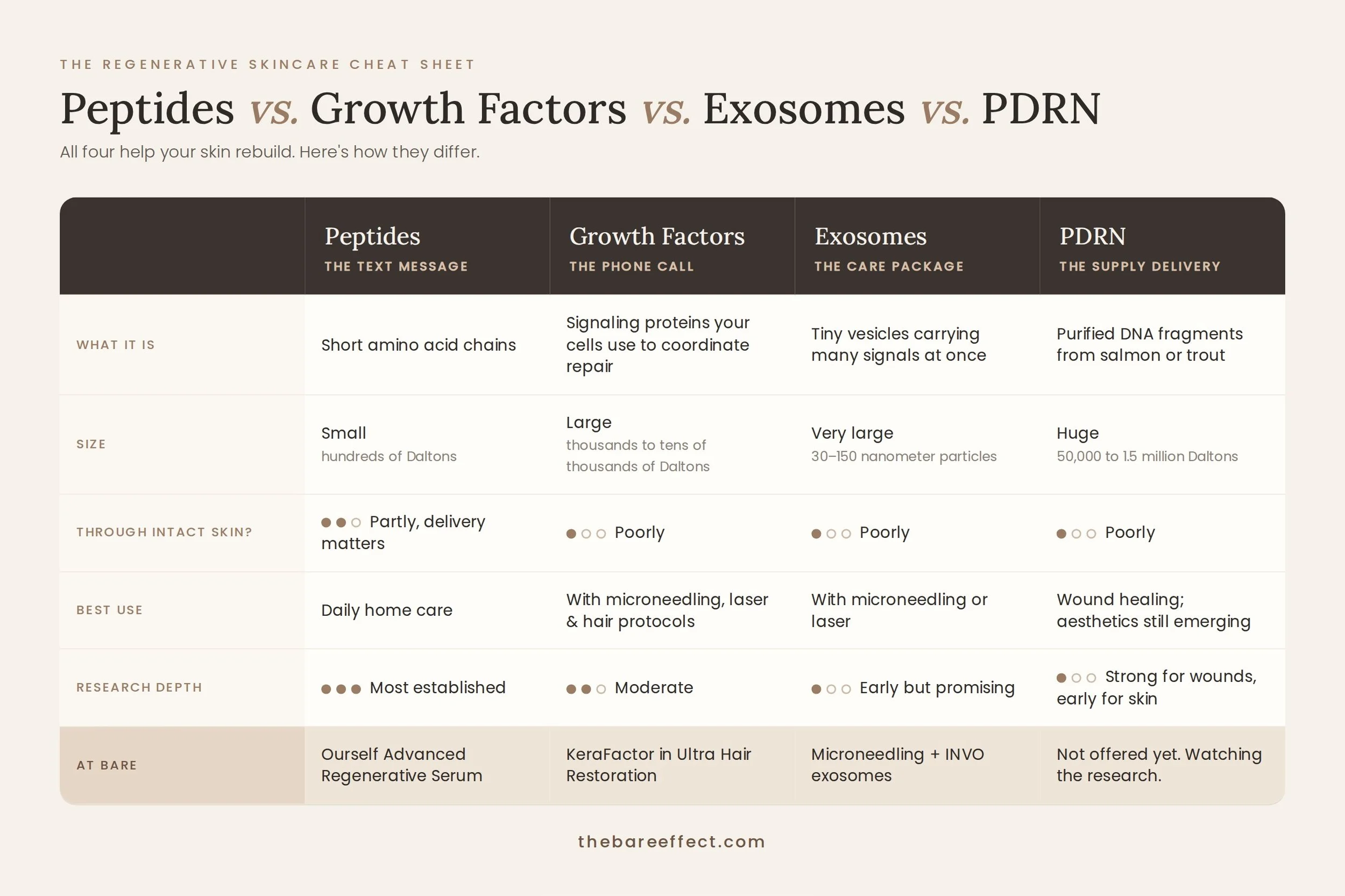
Comparison chart of peptides vs growth factors vs exosomes vs PDRN for skin: what each is, size, skin penetration, best use, research depth, and how Bare uses each.
So Which One Do You Actually Need?
Honestly? They work best as a team, but the right combo depends on where you are:
Prevention mode (20s to mid-30s): A good peptide serum every day, SPF every morning, and a retinoid at night.
Seeing texture, lines, or scarring: Keep the home routine and add a microneedling series with exosomes. Most people do best with a series of three to four sessions spaced four to six weeks apart.
Thinning hair: Growth factors delivered to the follicle with Ultra Hair Restoration, plus a look at what's driving the loss.
Curious about PDRN: Ask me at your next visit. I'm happy to talk through the latest research and whether it'd make sense for you as the evidence grows.
Stressed, under-slept, or in a hormonal transition (perimenopause, menopause, low T): All of the above, plus the next section.
Even More Important than the Serum: The Receiver
Your skin is an organ. During healing, pulls from the same resources as the rest of your body, so your overall health decides how well it can answer to the signals these ingredients are sending. Here are the biggest deterrents to getting the results you want that I see on a regular basis:
Sleep. Your skin does most of its repair overnight. In one study, poor sleepers showed more signs of skin aging and their skin barrier recovered about 30% less after injury than good sleepers' did. (Oyetakin-White et al., 2015) ⚑
Stress and cortisol. Chronically high cortisol breaks collagen down and suppresses the fibroblasts trying to rebuild it. It also slows wound healing, which is exactly what microneedling and laser depend on.
Diet. Collagen is built from protein and needs vitamin C to form properly, so a diet low in either gives your fibroblasts less to work with. High-sugar eating works against you too: excess sugar binds to collagen and forms advanced glycation end products (AGEs), which leave fibers stiff and brittle. (Danby, 2010) ⚑
Thyroid. An underactive thyroid slows cell turnover and can leave skin dry, thin, and slow to heal.
Hormones. Your fibroblasts have receptors for estrogen and androgens. Estrogen supports collagen, thickness, and hydration, which is why skin changes so fast around menopause. Low testosterone affects skin thickness and repair in men.
Gut health and inflammation. Chronic inflammation anywhere in the body shows up in the skin, and your gut plays a big role in how much of it you're carrying.
How to Spot the Hype
Before you buy anything with one of these words on the label, ask:
Is the source disclosed? Especially for exosomes and growth factors. "Proprietary" isn't an answer.
Was the study done on this product or just the ingredient? A great study on Matrixyl doesn't automatically mean a random serum with a trace of it works. This happens all the time in the skincare industry, and it's shady.
How does it get in? Big molecules on intact skin mostly stay on the surface.
Does it claim to treat a disease? No exosome product is FDA-approved to treat anything. Big medical promises are a red flag.
"Stem cell" skincare: Plant stem cell extracts don't act like human stem cells in your skin. Nice ingredient, but its a very different claim.
Is the injectable FDA-approved? For PDRN and PN, the answer in the US is no. Ask what product is being used and where it came from.
Frequently Asked Questions
Are exosomes better than PRP? For most of my patients, I prefer exosomes because they're standardized. PRP depends on your own platelets, which vary from person to person and day to day. Exosome research is still young, so I'm transparent about that, but in my practice they give more predictable results.
Are exosomes safe? In the published aesthetic studies paired with microneedling and laser, side effects have been mild and temporary (redness, mild swelling). Long-term data is still limited, and no exosome product is FDA-approved, which is why the source and the provider matter so much. While I am approached regularly by distributors, I am incredibly picky about the ones I have chosen.
Can I use peptides with retinol or vitamin C? Generally, yes, and they pair well. If you're using copper peptides, I usually suggest keeping them separate from strong acids and high-strength vitamin C (for example, peptides at night, vitamin C in the morning). Ourself’s Advanced Regenerative Serum that we carry has formulated all together.
Do growth factor serums increase cancer risk? There's no evidence that topical growth factors cause skin cancer. Some experts raise it as a theoretical question since growth factors stimulate cell activity. If you have a personal history of skin cancer, talk it through with your provider before starting one.
Is PDRN the same as a "salmon sperm facial"? Yes, that's the viral name for it. PDRN is purified DNA fragments from salmon or trout. The fish part sounds strange, but DNA is structurally similar across species, which is why it can serve as raw material for your own cells.
Is PDRN better than exosomes? They do different jobs. Exosomes deliver a package of signals; PDRN supplies building blocks and calms inflammation. Right now, exosomes have more direct aesthetic research paired with microneedling, while PDRN's strongest evidence is in wound healing.
Why doesn't Bare offer PDRN? The form with the most aesthetic research is injectable, which isn't FDA-approved in the US and isn't something I offer. Topical PDRN has the same size problem as other large molecules. I'm watching the research and will let you know if that changes.
How many microneedling + exosome sessions will I need? Most people see the best results with a series of three to four sessions, four to six weeks apart, then maintenance a few times a year.
To Sum it Up
Peptides, growth factors, exosomes, and PDRN are all ways of helping your skin rebuild. Peptides are your everyday maintenance. Growth factors and exosomes are bigger, more powerful messages that work best when we help them in. PDRN is the promising newcomer with a strong wound-healing track record and aesthetic research that's still catching up. None of them work to their full potential if the body receiving the message is running on poor sleep, high stress, a thin diet, or out-of-balance hormones.
That's how I approach every plan at Bare: the right signal, the right delivery, and a body that's healthy enough to respond.
Book Microneedling + Exosomes → Here
Shop Ourself Advanced Regenerative Serum →Here
Book a Consultation →Here
Christalyne Causey, PhD, is a hormone specialist, licensed esthetician, and the founder of Bare Aesthetics Skincare & Nutrition in Scottsdale, AZ. She practices integrative aesthetics, combining hormone optimization, evidence-based skin care, and advanced aesthetic treatments for results that hold.
Related reading:
Microneedling and Collagen: What's Actually Happening Under Your Skin
Why Your Skincare Isn't Working: The Delivery Problem Nobody Talks About
Ultra Hair Restoration: How Laser-Assisted Growth Factors Reach the Follicle
Sources
Robinson LR, et al. Topical palmitoyl pentapeptide provides improvement in photoaged human facial skin. Int J Cosmet Sci. 2005;27(3):155–160.
Blanes-Mira C, et al. A synthetic hexapeptide (Argireline) with antiwrinkle activity. Int J Cosmet Sci. 2002;24(5):303–310.
Bos JD, Meinardi MM. The 500 Dalton rule for the skin penetration of chemical compounds and drugs. Exp Dermatol. 2000;9(3):165–169.
Fitzpatrick RE, Rostan EF. Reversal of photodamage with topical growth factors: a pilot study. J Cosmet Laser Ther. 2003;5(1):25–34.
Quinlan DJ, et al. Topical growth factor preparations for facial skin rejuvenation: a systematic review. J Cosmet Dermatol. 2023.
Kwon HH, et al. Combination treatment with human adipose tissue stem cell-derived exosomes and fractional CO2 laser for acne scars: a 12-week prospective, double-blind, randomized, split-face study. Acta Derm Venereol. 2020;100(18):adv00310.
Park GH, et al. Efficacy of combined treatment with human adipose tissue stem cell-derived exosome-containing solution and microneedling for facial skin aging: a 12-week prospective, randomized, split-face study. J Cosmet Dermatol. 2023.
U.S. Food and Drug Administration. Consumer Alert on Regenerative Medicine Products Including Stem Cells and Exosomes. 2020, updated 2024.
Brincat M, et al. Sex hormones and skin collagen content in postmenopausal women. Br Med J. 1983. ⚑
Oyetakin-White P, et al. Does poor sleep quality affect skin ageing? Clin Exp Dermatol. 2015;40(1):17–22. ⚑
Danby FW. Nutrition and aging skin: sugar and glycation. Clin Dermatol. 2010;28(4):409–411. ⚑
INVO Aesthetics. The Science of BioBlend Technology. invoaesthetics.com/pages/science
Squadrito F, et al. Pharmacological activity and clinical use of PDRN. Front Pharmacol. 2017;8:224.
Squadrito F, et al. Polydeoxyribonucleotide, an adenosine-A2A receptor agonist, preserves blood flow and increases healing of diabetic foot ulcers. Clin Pharmacol Drug Dev. 2014.